Last month my neighbour Priya texted me a photo of her three Kratky jars. Two had yellowed. One had a wilted lettuce stem leaning against the rim like it had given up halfway. “I followed everything you wrote,” the message said. And she had.
That was the moment I changed my mind. For about a year I’d been telling everyone — friends, readers, my own cousin — that the cheapest, easiest way to try hydroponics in an Indian apartment is the Kratky method. A jar, some water, a net pot, no pump, no electricity. What’s not to love? Turns out, plenty.
Kratky Is Brilliant. It’s Also Quietly Brutal on First-Timers.
The Kratky method was developed by Dr. Bernard Kratky at the University of Hawaii as a non-circulating hydroponic technique meant for commercial lettuce farmers with reliable inputs and consistent climate. Read that sentence again. Commercial. Reliable inputs. Consistent climate. None of those three things describe a first-time grower in a Bengaluru 2BHK in May.
On paper, Kratky is one jar plus one mistake away from working. In practice it’s one jar plus five hidden assumptions away from working — and nobody tells beginners which five.
The Five Things Nobody Warns You About
One — water level is unforgiving. If the gap between the bottom of the net pot and the water surface is wrong by half a centimetre, roots either drown or never reach the water at all. There’s no second chance. A pump-based system forgives this. Kratky does not.
Two — temperature creeps. Sitting water in an Indian summer hits 32–34°C inside the jar. At that temperature, dissolved oxygen plummets and roots start rotting. Pump systems aerate around this problem. Kratky has nothing to lean on.
Three — you only find out it’s failing when it’s already failed. No noise, no alarm, no visible water flow. The plant looks fine on day 9 and dead on day 12. Beginners don’t yet know what “fine” looks like, so they miss the signal entirely.
Four — algae is a beginner-killer. Clear glass jars on a window sill grow algae within ten days. Algae steals nutrients, drops pH, makes the whole thing smell. Every Kratky tutorial mentions “use opaque containers” as a footnote. It should be the headline.
Five — there’s no recovery path. Top up wrong, dead. Mix nutrients wrong, dead. Crop wrong, dead. With a recirculating DWC, you flush, refill, and the plants survive. Kratky is single-shot. That is a terrifying first experience for someone who’s never grown anything.
So Why Did I Recommend It for So Long?
Honest answer? Because I liked it. I’d already grown things in soil for years before I tried Kratky. I knew what a sad plant looked like at day 7. I had a TDS meter, an RO can, and the patience to babysit. What worked for me wasn’t going to work for someone whose only previous experience with plants was watching their mom’s tulsi survive on prayer.
I confused “simple” with “easy.” Those aren’t the same word. A bicycle is simpler than a car. It also requires balance you don’t have on day one.
What I Tell Beginners Now
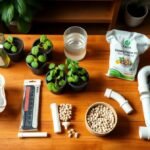
Start with a small pump-based DWC tray. Six net pots, one ₹120 air pump, a length of tubing, an air stone. About ₹600 all-in. The pump bubbles, you can hear it working, and the constant aeration buys you a wide margin of error on temperature, water level, and root health. Mess up the nutrients? Flush and refill. Forget about it for three days? Plants are still alive.
I sent Priya a parts list the same evening. Her replacement DWC tray has been running for 23 days. The lettuce is back. So is her interest in trying it again — and that, more than any single harvest, is what matters when you’re talking to a beginner.
If anyone wants the exact tray I now recommend, I broke down the parts and prices in my ₹2,000 budget setup post. There’s nothing fancy in it. That’s the point.
When Kratky Still Earns Its Place
I haven’t abandoned the method. I still run two Kratky jars on my own window sill — basil and pudina, both forgiving crops, both planted in opaque jars I painted black on the outside. They’ve outlived three monsoons. For someone who already understands how hydroponics fails, Kratky is genuinely beautiful.
For someone who doesn’t, it’s a confidence-killer dressed up as a beginner project. The ICAR-IIHR team in Bengaluru, in their extension notes on protected cultivation, point out the same thing in less dramatic language: passive systems are best deployed where the operator already understands the variables. They’re not wrong.
If you’ve been on the fence about your first hydroponic build and someone — including past me — told you to start with a Kratky jar because it’s “the easiest,” consider this a friendly correction. Spend the extra ₹300. Buy the pump. Give yourself room to make mistakes that don’t end in a yellowed plant and a quietly disappointed text message at 11 PM.